As property developers, facility managers, and structural experts operating in Indonesia, we understand that building safety is about much more than just pouring strong concrete. We live and work in one of the most active seismic regions on the planet. For us, safeguarding our properties against earthquakes is not just a regulatory hurdle; it is a fundamental requirement for business continuity, tenant safety, and asset protection.
When an earthquake strikes, the immediate aftermath is filled with uncertainty. Building owners and management teams must make rapid, high-stakes decisions. Should we evacuate the entire commercial complex? Is the high-rise safe for re-occupation? Did the foundation sustain invisible damage? In the past, we had to wait days for visual inspections to answer these questions. Today, compliance and safety standards demand immediate, data-driven answers.
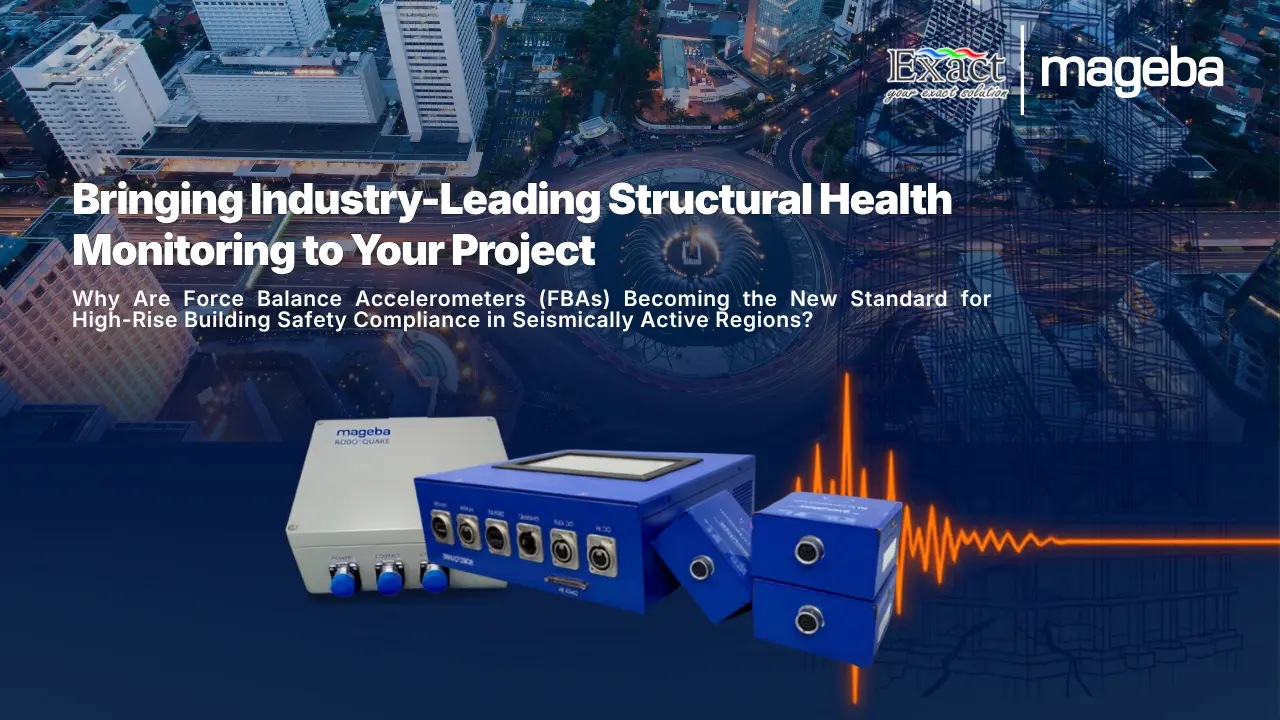
To achieve this level of operational readiness, we rely on a specialized Earthquake monitoring tool for buildings, ROBO®QUAKE. This advanced platform serves as the central nervous system for our infrastructure. It is an off-the-shelf, IoT-compatible monitoring solution that empowers decision-makers to respond quickly, minimize downtime, and dramatically enhance life safety.
In this comprehensive guide, we will explore exactly how this technology ensures the complete seismic protection of buildings, how it meets strict engineering compliance requirements, and why it is the ultimate tool for modern property management.
Moving Beyond Standard Seismographs to True Structural Health Monitoring
There is a common misconception in property management that earthquake monitoring simply means checking the local news or having a basic vibration sensor in the basement. However, modern earthquake engineering requires us to understand exactly how our specific building reacts to ground motion. Standard seismographs measure the magnitude of the earthquake in the region, but they do not measure the potential damage to our actual structure.
This is why we implement a complete Structural Health Monitoring System (SHMS).
ROBO®QUAKE operates as a fully integrated SHMS that gives us continuous insight into the building’s structural integrity. By deploying a network of high-precision sensors throughout the property, we can assess the actual physical condition of the building based on continuously recorded measured variables. We can easily track global and local structural properties, spotting drifts in natural frequencies or accumulating stress over time. This allows us to predict the development of structural conditions with great accuracy, moving our maintenance strategy from reactive repairs to proactive compliance.
The “Before, During, and After” Compliance Framework
To truly protect a commercial or residential building, our monitoring strategy must cover the entire lifecycle of a seismic event. This tool is specifically tailored to provide actionable data before, during, and after an earthquake.
Before the Event: Establishing a Baseline Before any earthquake happens, the system continuously monitors the building to establish a baseline of “normal” vibration and response. It tracks daily micro-vibrations from wind, traffic, and general usage. By understanding this baseline, we can easily spot drifts in natural frequencies, increasing inter-storey drifts, and gradual tilt trends. This daily fatigue analysis helps us inform our long-term inspection and replacement planning.
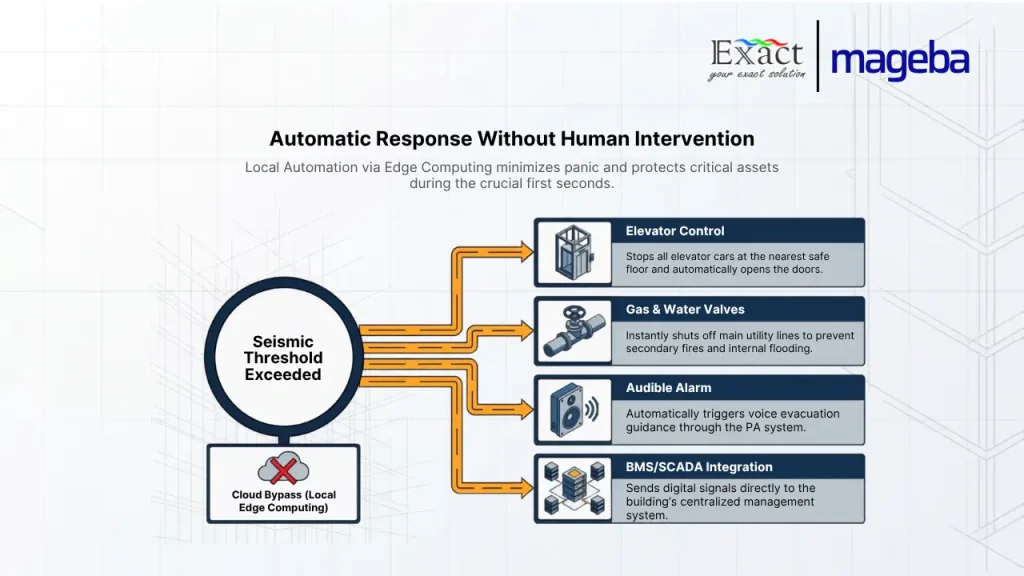
During the Event: Real-Time Action When an earthquake hits, the system captures the motion in real time. Because it is equipped with edge computing and smart analytics, the local data processing ensures that alarm triggering happens instantly, even if the building loses cloud connectivity. During the shaking, the system acts autonomously to protect the occupants through automated safety protocols.
After the Event: Fast Re-Occupation Decisions Immediately after the shaking stops, the system generates automated condition assessment reports. These reports are generated within minutes of the event. As building operators, this gives us clear, readable evidence regarding what zones to reopen, what areas to inspect further, and where to focus our emergency resources.
Precision Hardware: The Power of Force Balance Accelerographs
For our data to be reliable for compliance and insurance purposes, we must use industrial-grade, highly sensitive hardware. The heart of this system relies on standardly equipped 3D accelerographs.
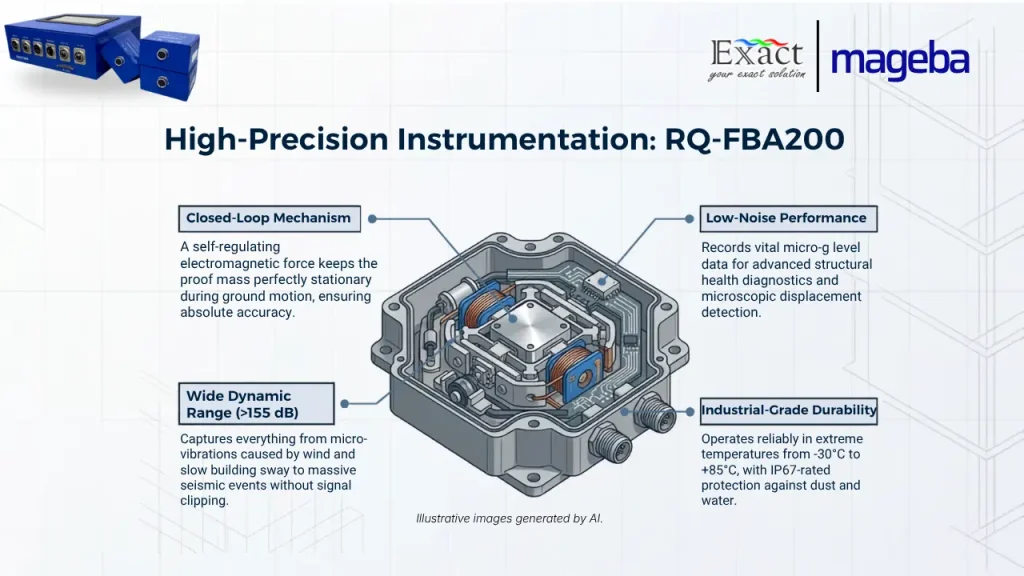
Specifically, the system utilizes Force Balance Accelerometers (FBAs). These are precision instruments designed to measure ground acceleration with extreme accuracy, particularly in low-frequency applications like structural monitoring.
Unlike conventional, cheaper sensors, our FBAs use a closed-loop feedback mechanism. This mechanism applies an electromagnetic force to counteract the movement of an internal proof mass, effectively keeping it stationary. The amount of force required to maintain this balance is directly proportional to the acceleration the sensor experiences. This unique design allows the FBAs to achieve a wide dynamic range, excellent linearity, and extremely low noise performance. This means we can detect incredibly small or slow structural motions over long periods without data interference.
The main data unit and these sensors are built for the harsh environments of building utility rooms, featuring IP67 ratings that make them completely dust-tight and water-resistant.
Strict Sensor Placement Guidelines for Building Compliance
When we install an Earthquake monitoring tool for buildings, ROBO®QUAKE, we cannot just place sensors randomly. To ensure accurate data collection and code compliance, we follow strict engineering guidelines based on the exact layout and height of the property.
Height-Based Requirements The total height of our building dictates the minimum hardware needed to capture the whiplash effect of an earthquake:
- If the building is 49 meters tall or below, we must install a minimum of 1 accelerometer sensor, typically at the base or critical load path.
- If the building is 50 meters or above, we are required to install a minimum of 3 accelerometer sensors. These are generally placed at the bottom, middle, and top floors to accurately measure the inter-storey drift and the twisting motion of the high-rise.
Handling Structural Seismic Gaps Large commercial complexes and malls often feature structural seismic gaps. These gaps allow different sections of a massive building to move independently during an earthquake, preventing them from tearing each other apart.
- If our building has 1 seismic gap per floor, the building is treated as 2 separate sections.
- If there are 2 seismic gaps per floor, the building is divided into 3 independent sections.
- We must install the required number of sensors in each separate divided section to ensure complete compliance. For example, a high-rise building with two seismic gaps will require 3 sensors per section, totaling 9 sensors.
Managing Multiple Buildings and Estates For developers managing sprawling estates, we must look at the distance between assets. If we are monitoring multiple buildings that are located more than 1.2 kilometers apart, independent monitoring systems must be deployed. Furthermore, if the buildings share common infrastructure—such as a shared underground parking garage or a central utility room—this shared base can influence how the vibrations travel, requiring a synchronized, networked approach.
Automated Actuation of Building Protection Equipment
One of the most dangerous elements of an earthquake is not the shaking, but the secondary hazards that follow, such as fires, explosions, and flooding. Our compliance strategy must actively mitigate these risks.
This system acts as an active safety barrier by directly integrating with our building protection equipment. When the sensors detect that ground acceleration has crossed a dangerous, predefined threshold, the main data unit triggers immediate, life-saving automated actions:
- Elevator Control: The system automatically signals the elevator banks to stop at the nearest safe floor and open the doors, preventing tenants from being trapped in the shafts during power outages.
- Gas Line Shut-Off: It automatically shuts off main gas valves to eliminate the risk of massive fires and explosions from ruptured pipes.
- Water Supply Shut-Off: It closes water supply lines to prevent interior flooding, which can cause millions of dollars in secondary property damage.
- Fire Suppression Activation: The system can directly activate sprinkler and fire suppression systems if needed.
- Evacuation Alarms: It instantly activates loud evacuation alarms and delivers acoustic warning messages over the building’s Public Address (PA) system, guiding our occupants to safety without waiting for human intervention.
By automating these processes, we completely remove the delay of human hesitation during a terrifying event.
Seamless Integration of Additional Sensors
While accelerometers provide our core seismic data, a true structural health monitoring system (SHMS) must be adaptable to the specific weaknesses of our property. The main data unit features multiple input channels, allowing us to connect virtually any type of measurement technology to expand our oversight.
Depending on our structural engineers’ recommendations, we can easily integrate:
- Displacement Sensors: Using inductive or wire sensors to measure concrete crack widening or expansion joint movements.
- Tilt Sensors: To track the gradual leaning of the building over years of ground settlement.
- Strain Gauges: To measure the compressive and shear loads on our primary load-bearing columns.
- Concrete Temperature and Humidity Sensors: To track how environmental factors are affecting the internal reinforcement bars.
This means we can use the system not just for earthquakes, but for daily fatigue analysis, overload detection, and evaluating the impact of nearby construction or blasting on our foundation.
Leveraging the Digital Twin Platform for Portfolio Management
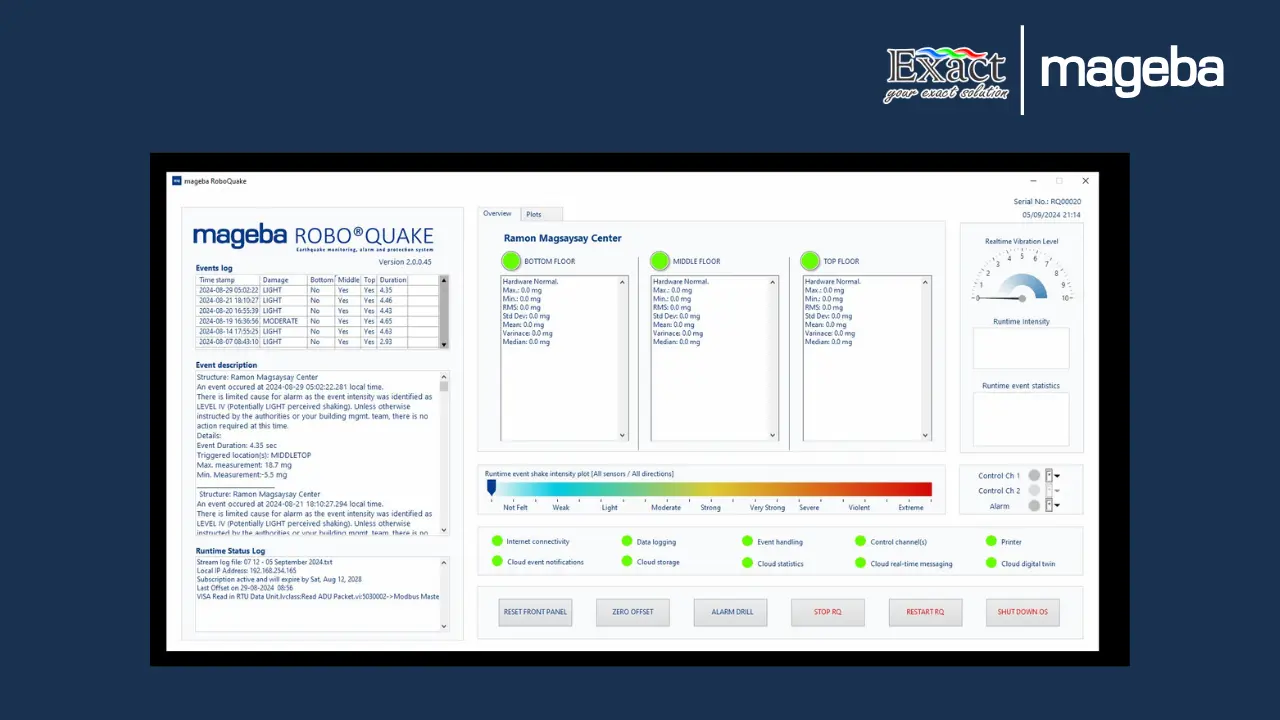
For property developers and asset managers overseeing multiple high-rises or commercial centers, logging into a dozen different systems is highly inefficient. We require a centralized, high-level view of our entire portfolio.
The data collected by the hardware is seamlessly transmitted to the cloud, forming the backbone of our Digital Twin Platform. This cloud-based system digitally replicates our structures and components. It provides us with:
- Multi-Asset Monitoring Dashboards: A single, real-time dashboard where we can view the status of multiple projects and properties at once.
- 3D Model Viewers: Visual representations of our structures, allowing us to pinpoint exactly where stress or vibration is occurring.
- Forecasting and Strategic Planning: By collecting historical data over months and years, the platform empowers us to make data-driven decisions regarding lifecycle optimization and maintenance budgets.
This cloud functionality ensures transparency across the entire lifecycle of our assets, providing clear, measurable risk profiles that we can present to authorities, designers, and our insurance providers.
Instant Event Reporting and Real-Time Information
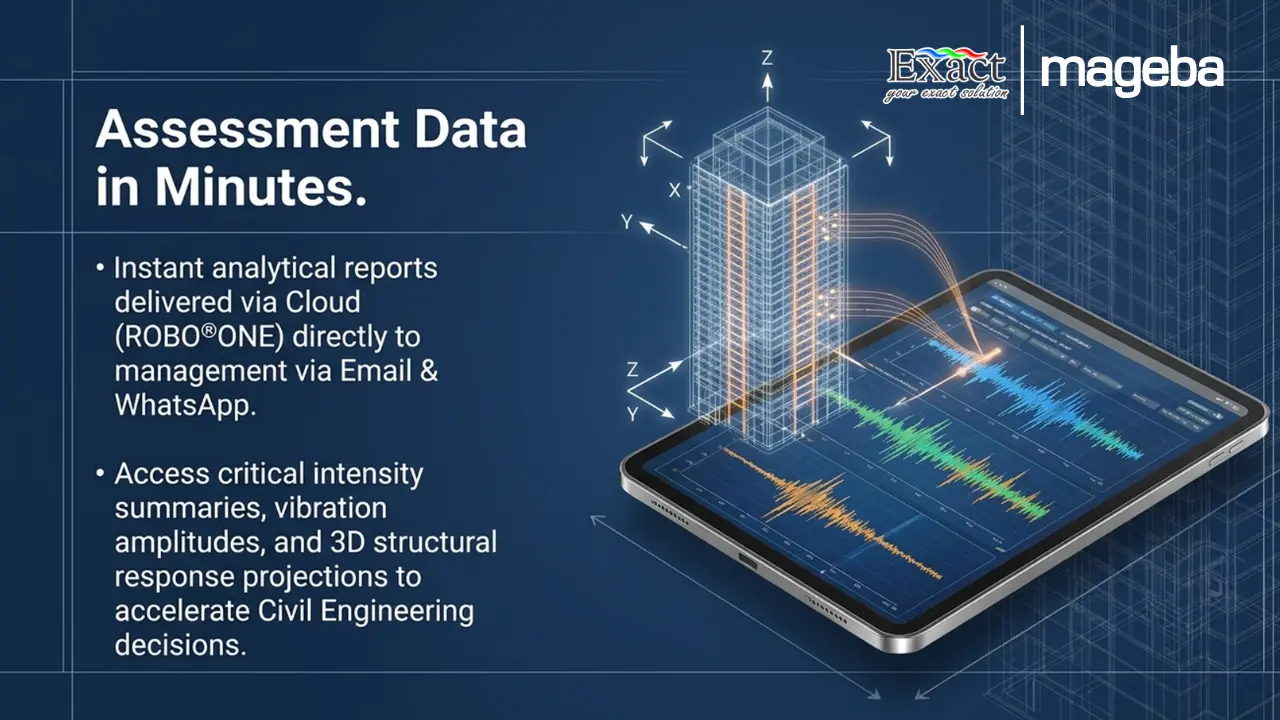
When an earthquake happens, our building management teams and engineers need immediate, readable data, regardless of where they are in the world.
The system provides real-time information via a highly secure web interface and mobile application. The moment an event is recorded, the system sends immediate notifications through SMS, email, and WhatsApp directly to our designated management personnel.
Furthermore, within minutes of the shaking stopping, the system automatically generates a detailed Event Report. This is not a confusing spreadsheet of raw numbers; it is a clear, actionable document. The report includes:
- A summary of the shaking intensity and the exact duration of the event.
- Maximum and minimum acceleration, velocity, and displacement statistics.
- Visual plots showing the acceleration time history.
- Frequency domain charts and response spectrums.
- 3D projections showing exactly how the building swayed and displaced on its X, Y, and Z axes.
If local internet goes down during the disaster, the data is never lost. The system processes the data locally, and facility managers can view the results on the main data unit’s LCD display screen. They can even print the reports immediately using the unit’s built-in printer, ensuring on-site teams have the data they need to make evacuation decisions.
Flexible Subscription Tiers to Match Developer Needs
We know that different buildings have different budgets and risk profiles. To make this IoT-compatible monitoring solution scalable, the platform requires an end-customer subscription that activates the device and its cloud features. We offer three tailored tiers: Essential, Premium, and Ultra.
- Essential Tier: Ideal for standard compliance. It covers up to 5 users, provides email and WhatsApp alerts, includes automated software updates, hardware health monitoring, and local data processing with threshold alarms.
- Premium Tier: Designed for advanced risk management. It adds powerful features like AI-driven predictive diagnostics, AI-driven event classification, and pattern recognition to detect material fatigue and cyclic stress. It also includes weekly system-status reports and automated escalation call alerts.
- Ultra Tier: The ultimate choice for large-scale property developers. This tier unlocks the Multi-Asset Monitoring Dashboard, provides permanent data storage for both event and non-event data, and includes 24/7 technical support. It ensures total, uninterrupted oversight of a massive real estate portfolio.
Ensuring Long-Term Value and Public Trust
Ultimately, investing in the Earthquake monitoring tool for buildings, ROBO®QUAKE, is about protecting our bottom line, reducing our liability, and ensuring the absolute safety of the people who live and work in our buildings.
By detecting micro-seismic activity, tracking long-term structural behavior, and automating life-saving responses, we enhance our property’s brand value. We build trust with our tenants by showing them we utilize the world’s most advanced earthquake engineering technologies to keep them safe. Furthermore, by replacing guesswork with hard, measurable data, we significantly reduce the costs associated with manual structural inspections after minor tremors.
We no longer have to wonder if our building is safe. We have the real-time data to prove it.
Frequently Asked Questions (FAQ)
What exactly is an earthquake monitoring tool for buildings?
It is a sophisticated network of sensors—primarily accelerographs—and a central data processor installed inside a property. Tools like ROBO®QUAKE continuously measure the vibration status of structural components, assess building health, and provide automated safety responses during an earthquake.
How does this system differ from standard regional earthquake alerts?
Regional alerts tell you that an earthquake happened nearby. Our Structural Health Monitoring System (SHMS) tells you exactly how your specific building absorbed that energy. It measures the potential damage to your actual structure, tracking inter-storey drift, tilt, and displacement.
Can this system actively prevent post-earthquake disasters?
Yes. Through edge computing, the system can automatically trigger building protection equipment the moment a threshold is crossed. It can stop elevators safely, shut off main gas and water valves, and activate public address alarms to initiate safe evacuations.
What happens to the data if the power and internet fail during a disaster?
The main data unit is equipped to handle localized failures. It processes data locally using edge computing. Building managers can view the event results directly on the unit’s LCD screen and print physical copies of the assessment reports using the built-in printer, without needing cloud access.
How do I determine how many sensors my building requires for compliance?
Sensor placement depends on building geometry. Buildings under 50 meters require at least 1 sensor, while buildings 50 meters or taller require a minimum of 3 sensors. Additional sensors are mandatory if your building is divided by structural seismic gaps to accurately monitor each separate section.
About Us
At PT. Exact Global Teknologi, we are committed to elevating the safety and resilience of Indonesia’s infrastructure. We provide industry-leading structural health monitoring systems and expert guidance to help property owners, developers, and engineers navigate the complexities of seismic compliance. Protect your investments and your tenants with confidence.
Exact Global Teknologi
Website : www.exactglobal.co.id
Email Marketing : marketing@exactglobal.co.id
WhatsApp : +62 812-9252-3900