When a 6.5 magnitude earthquake strikes a modern commercial center, physical structural damage accounts for less than 30% of the total financial loss. The remaining 70% vanishes through prolonged operational paralysis, where a single day of forced closure can cost high-rise owners upwards of $50,000 in lost revenue and idle business activities. Sitting directly on the active Pacific Ring of Fire, Earthquakes in Indonesia present a continuous threat to our built environment. While we often focus on physical collapse, the true threat to commercial real estate is prolonged uncertainty. Making a strategic Investment in Building Seismic Monitoring Systems allows us to transform how we manage seismic risk, moving from defensive closures to rapid, data-backed re-entry.
The Invisible Risk of Building Operational Downtime
When seismic shock waves pass through an urban area, standard emergency protocols require immediate occupant evacuation. Once the shaking stops, the clock begins ticking on Building Operational Downtime. For commercial high-rises, retail malls, and industrial facilities, downtime represents an immediate financial freeze. Every hour our property sits empty, tenant transactions halt, manufacturing lines stall, and office productivity drops to zero.
This operational freeze damages tenant relationships and undermines asset stability. If we cannot provide clear, data-verified safety status quickly, we face lease abatement demands, potential breach of contract claims, and permanent tenant flight. Calculating the true Post-Earthquake Building Downtime Cost involves measuring both direct lost rental income and indirect liabilities, such as paying idle staff and facing business interruption claims. In active seismic zones across Java, Sumatra, and Sulawesi, a single week of unnecessary closure can easily exceed the entire expense of installing dedicated monitoring infrastructure.
Comparing Safety Assessments: Manual vs. Automated Verification
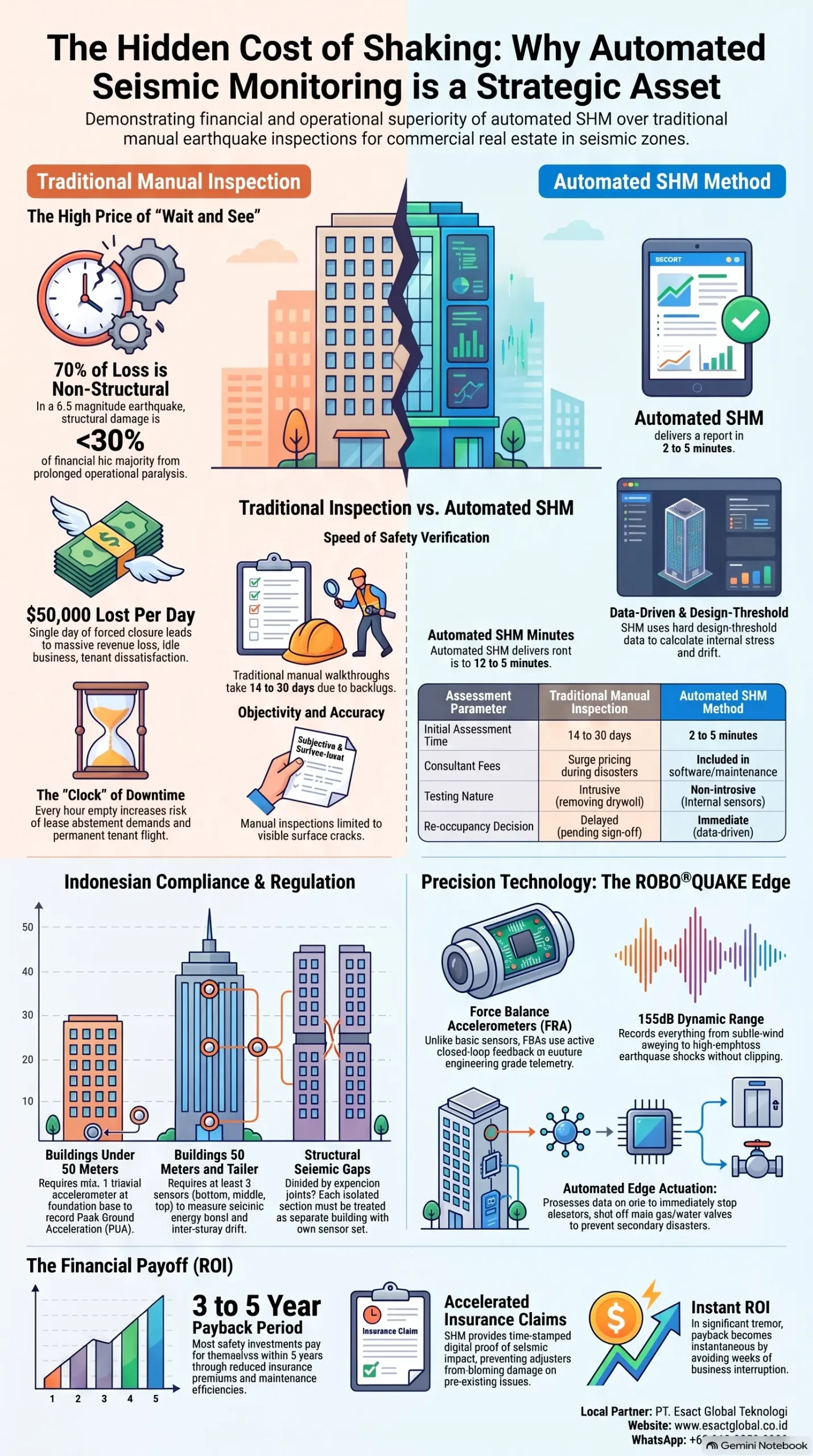
Under standard regulations, a building cannot be legally re-occupied following a major tremor until its structural integrity is formally verified. Traditionally, this relies on hiring structural engineers to conduct visual walkthroughs. This manual approach introduces a heavy Post-Earthquake Structural Inspection Cost that many property owners fail to budget for.
Visual inspections are inherently subjective and slow. An engineering team can check for superficial concrete cracks, but they cannot see inside core shear walls or evaluate internal steel fatigue. Because qualified structural consultants face massive backlogs during regional disasters, securing an on-site inspection team can take weeks.
To understand how automated technology changes this timeline, we can compare traditional manual inspections with automated Structural Health Monitoring (SHM) methods:
| Assessment Parameter | Traditional Manual Inspection | Automated SHM Method |
| Initial Assessment Time | 14 to 30 days (due to engineering backlogs) | 2 to 5 minutes (automated event report) |
| Engineering Consultant Fees | Surge pricing during regional disasters | Covered within system software and maintenance |
| Intrusive Testing Needs | Requires removing drywall or finishes to inspect joints | Non-intrusive continuous internal stress sensing |
| Assessment Accuracy | Subjective, limited to visible surface cracks | Objective, data-driven force and drift calculations |
| Re-occupancy Decision | Delayed pending physical engineering sign-off | Immediate, based on hard design-threshold data |
High-Precision Instrumentation: How Building Earthquake Sensors Work
Understanding how building earthquake sensors work requires looking at the engineering behind specialized motion sensing. Standard commercial motion sensors or basic MEMS chips are too noisy and lack the resolution required to capture complex, low-frequency structural vibrations. To gather engineering-grade telemetry, we rely on specialized Triaxial Force Balance Accelerometers.
Platforms like mageba’s ROBO®QUAKE deploy the advanced RQ-FBA200 model sensor. Unlike conventional open-loop sensors, a Force Balance Accelerometer (FBA) uses an active closed-loop feedback mechanism. Inside the sensor, a proof mass is suspended. When ground motion occurs, an internal electromagnetic coil applies a precise counteracting force to keep the proof mass completely stationary relative to the housing. The electric current needed to maintain this balance is directly proportional to the physical acceleration experienced by the structure.
This design delivers exceptional performance metrics:
- Wide Dynamic Range: Exceeds 155dB, allowing the system to record subtle micro-vibrations from wind swaying and daily traffic without clipping during high-amplitude earthquake shocks.
- Ultra-Low Self-Noise: Operates at the micro-g level, keeping noise performance well below the Accelerometer Low Noise Model (ALNM) threshold for early structural diagnostics.
- Broad Frequency Response: Captures dynamic motion from DC up to 215Hz, acquiring data at rates up to 1,500 samples per second (SPS).
- Industrial Durability: Housed in IP67-rated weather-proof enclosures designed to operate in extreme temperature ranges from -30 °C – +85 °C.
Strict Code Compliance: Height and Layout Regulations
Collecting legally compliant structural telemetry requires adhering to strict regulatory guidelines regarding sensor layout and spatial distribution. In Indonesia, building geometry and height dictate the minimum sensor count to satisfy building safety standards:
- Buildings Below 50 Meters: Require a minimum of 1 triaxial accelerometer, typically installed at the foundation base to record incoming Peak Ground Acceleration (PGA).
- Buildings 50 Meters or Taller: Require a minimum of 3 triaxial accelerometers strategically placed at the bottom, middle, and top floors. This vertical distribution measures how seismic energy travels upward and calculates Peak Ground Velocity (PGV), Peak Ground Displacement (PGD), and inter-storey drift.
- Structural Seismic Gaps: If a massive structure is divided by expansion joints or seismic gaps, each isolated section moves independently during a quake. Regulations dictate that each independent section must be treated as a separate building and outfitted with its own full set of height-compliant sensors.
- Estate Distance Rules: If properties within a single development estate are located more than 1.2 kilometers apart, they cannot share a single central sensing network. Independent monitoring units are required for each sub-cluster, while shared basement garages or utility rooms require synchronized networked telemetry.
Accelerating Post-Earthquake Property Insurance Claims
Settling insurance payouts for structural damage can be a slow, contentious process. Insurance adjusters routinely scrutinize physical claims, attributing cracks and structural misalignment to pre-existing concrete creep, foundation settlement, or poor maintenance rather than recent seismic activity. Without objective empirical data, Post-Earthquake Property Insurance Claims can be delayed for months or denied entirely.
Continuous monitoring flips this dynamic in our favor. The ROBO®QUAKE system records every micro-g of acceleration and structural displacement throughout an event. When we file a claim, we can submit an automated Event Report containing time-stamped Peak Ground Acceleration numbers and 3D movement projections across the X, Y, and Z axes. This scientific evidence proves the direct causal relationship between the ground shaking and the structural impact. Providing underwriters with undeniable physical proof accelerates claim adjustments and helps secure faster payouts. Furthermore, maintaining a certified monitoring system often qualifies commercial properties for reduced annual insurance premiums.
Strategic Continuity: Automated Emergency Protection Equipment
A complete Earthquake Business Continuity Plan requires rapid, automated crisis response. Secondary disasters—such as gas line explosions, localized flooding from ruptured water pipes, and trapped elevator occupants—frequently cause more financial loss and casualties than the shaking itself.
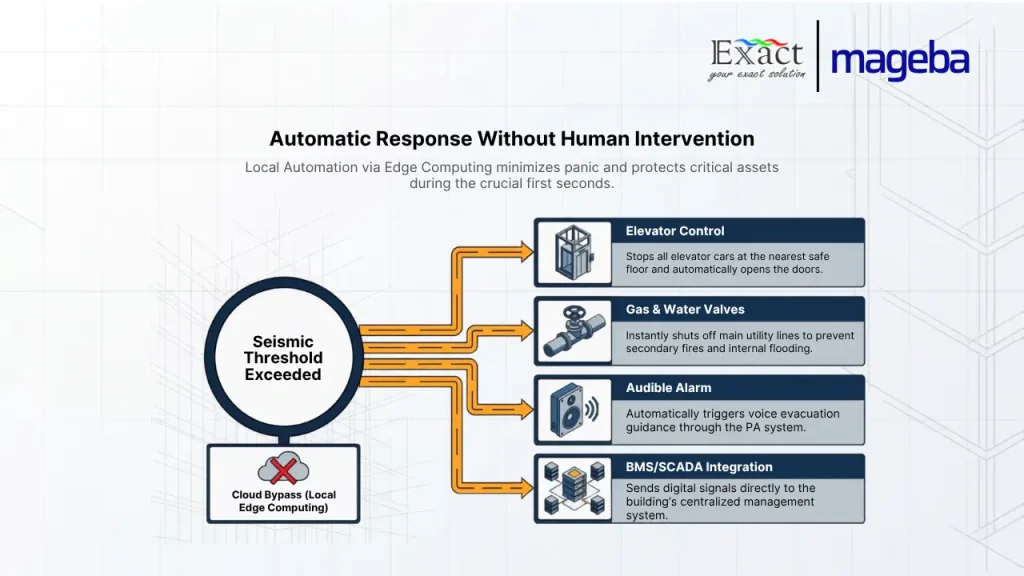
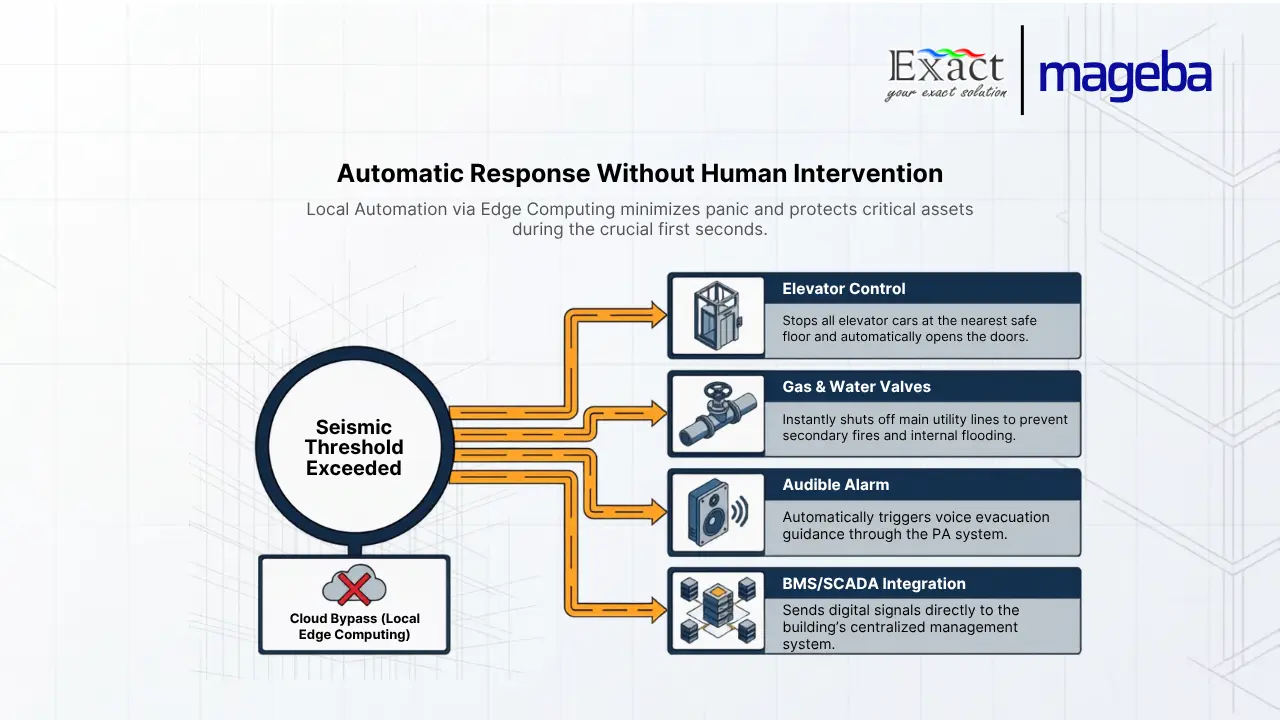
To prevent these hazards, modern SHM systems feature automated edge actuation. Using local edge computing within the Main Data Unit, the system processes sensor telemetry on-site without relying on external internet connectivity or cloud servers. If ground motion crosses a dangerous, predefined acceleration threshold, the system immediately actuates critical building equipment:
- Elevator Safety Control: Stops all active elevator cabs at the nearest safe floor and opens the doors immediately, preventing occupants from becoming trapped between floors.
- Automated Utility Shut-Off: Instantly closes motorized shut-off valves on main gas supply lines and main water mains, eliminating explosion risks and severe interior flooding.
- Acoustic Evacuation Alarms: Triggers public address (PA) alarms and broadcasts pre-recorded voice messages to guide tenants along safe evacuation routes.
- Building Management System (BMS) Integration: Sends direct digital signals to central BMS or SCADA networks for coordinated facility shutdowns.
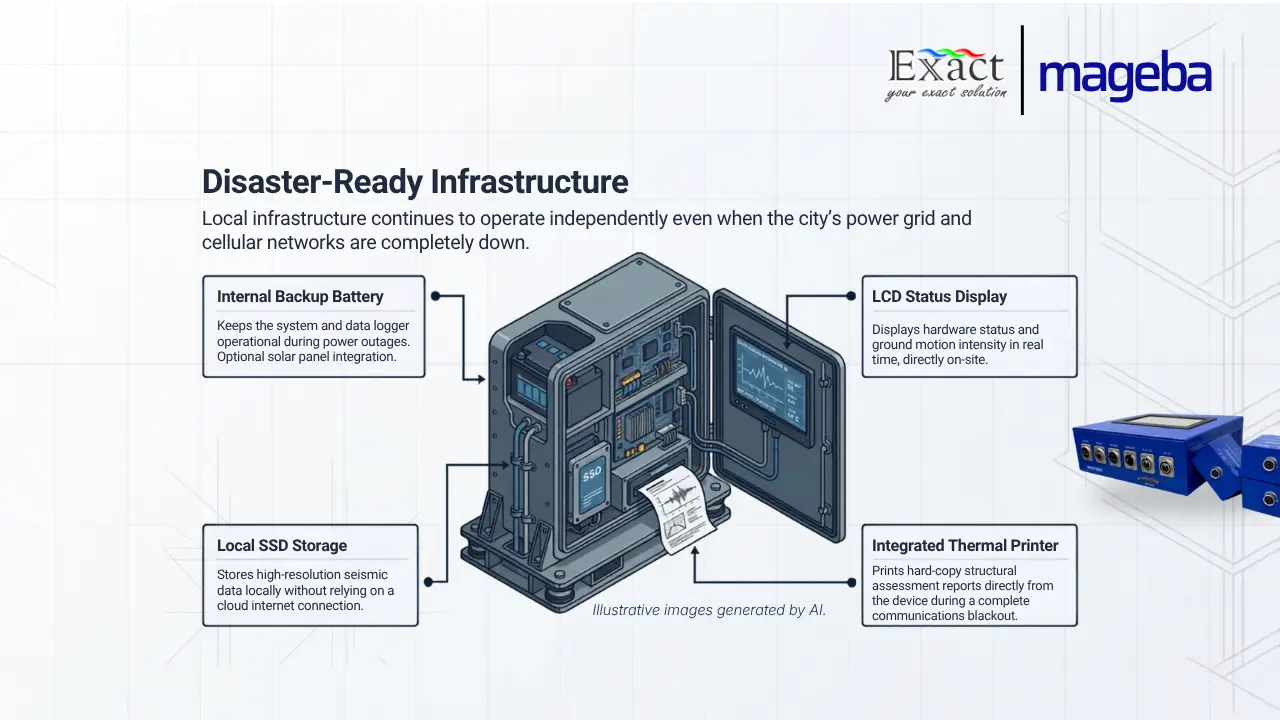
To guarantee continuous operation during severe regional power blackouts, the Main Data Unit includes hardware redundancy. Housed in a heavy-duty enclosure, the system features internal battery backups, optional solar panel pairing, local solid-state drive (SSD) storage, a top-panel LCD screen, and a built-in thermal printer. Emergency teams can print physical assessment reports directly from the machine on-site even during a complete blackout.
Evaluating the Monitoring System Total Cost of Ownership
When evaluating safety infrastructure, financial decision-makers must look beyond initial equipment purchases and analyze the Monitoring System Total Cost of Ownership. The financial commitment of a structural monitoring platform is structured across two primary expenditure categories:
- Capital Expenditure (CAPEX): Covers the core physical hardware. This varies based on building height and architectural complexity, which dictate whether a low-rise or high-rise hardware configuration is required. CAPEX includes the primary triaxial force-balance accelerometers, industrial enclosures, cabling, the Main Data Unit, and professional installation engineering.
- Operational Expenditure (OPEX): Involves ongoing operational support required to keep the system calibrated, compliant, and active. OPEX is structured around flexible software subscription tiers:
-
- Base Tiers: Cover essential software updates, hardware health monitoring, local data processing, threshold alarms, and instant email or mobile alerts.
-
- Mid-Range Tiers: Add machine learning tools for predictive diagnostics, event classification, concrete fatigue tracking, and automated call escalations.
-
- Advanced Tiers: Unlock multi-asset portfolio dashboards, permanent cloud data archiving, integrated cellular connectivity, and round-the-clock technical support.
By spreading operational expenses into manageable subscription structures, building owners can align their Commercial Building Disaster Risk Management budgets directly with their specific risk tolerance and asset size.
Proving Financial Viability: Cost-Benefit Analysis and ROI
Executing a rigorous SHM (Structural Health Monitoring) Cost-Benefit Analysis allows us to justify this technology to financial stakeholders. This analysis compares predictable capital expenditures against the catastrophic, unpredictable costs of operating unmonitored structures in active seismic zones.
Calculating your Structural Health Monitoring ROI involves evaluating three distinct value streams:
- Downtime Elimination: The primary return occurs during the first moderate earthquake. Instead of waiting two weeks for a visual inspection team while suffering lost lease payments, an automated report allows safe re-entry within minutes. The rental income saved during a single avoided shutdown frequently covers the entire system cost.
- Predictive Maintenance: Integrating real-time sensor streams into cloud-based Digital Twin platforms allows facility managers to track long-term concrete creep, foundation settlement, and microscopic joint shifts over decades. Machine learning flags structural anomalies early, shifting maintenance from expensive reactive repairs to low-cost predictive servicing.
- Asset Valuation & Payback Period: Properties equipped with real-time SHM command higher rental rates per square meter because corporate tenants—especially banks, multinational firms, and data centers—demand verifiable safety standards. The Building Safety Investment Payback Period is typically achieved within 3 to 5 years through reduced insurance premiums and maintenance efficiencies alone. However, if a significant tremor occurs, the payback period becomes instantaneous by averting prolonged business interruption.
Local Engineering Partnership: PT. Exact Global Teknologi
Deploying a compliant Structural Health Monitoring System requires localized technical expertise, from initial sensor placement design to ongoing calibration. In Indonesia, mageba’s advanced seismic safety systems are distributed and supported locally by PT. Exact Global Teknologi.
As a trusted partner in structural safety, geophysics, and disaster mitigation, PT. Exact Global Teknologi provides complete turnkey solutions for property developers, building owners, and structural engineering teams. Their specialist engineers assist clients through every project phase:
- Analyzing building geometries and calculating optimal, height-compliant sensor layouts.
- Executing professional hardware installations and wiring edge computing controllers.
- Interfacing local controllers directly with building elevators, utility valves, and BMS networks.
- Managing ongoing system calibration, cloud subscriptions, and technical support.
To request a customized seismic monitoring layout or schedule a technical consultation for your property, contact their engineering team directly:
- Company Name: PT. Exact Global Teknologi
- Official Website: www.exactglobal.co.id
- Email Marketing: marketing@exactglobal.co.id
- WhatsApp Support: +62 812-9252-3900
Frequently Asked Questions (FAQ)
What is an earthquake-resilient building, and how does SHM support it?
An earthquake-resilient building is designed and monitored to withstand ground shaking while maintaining human safety and operational continuity. A Structural Health Monitoring (SHM) system acts as the building’s central nervous system, using accelerometers to track structural strain, actuate safety equipment, and generate immediate safety assessments after a tremor.
How does an automated SHM system lower Post-Earthquake Structural Inspection Costs?
Instead of paying premium emergency fees for external engineering teams to perform slow, invasive manual walkthroughs, an SHM system processes raw acceleration data instantly. It generates automated, data-driven safety reports within minutes, eliminating inspection backlogs and drastically reducing consultant expenses.
What are the compliance requirements for sensor placement in Indonesian high-rises?
Sensor placement is governed by building height and geometry. Buildings under 50 meters require at least 1 triaxial sensor at the base. Buildings 50 meters or taller require at least 3 sensors placed at the bottom, middle, and top floors. If a building features structural seismic gaps, each isolated section must be outfitted with its own independent height-based sensor set.
Can real-time seismic monitoring data improve property insurance claims?
Yes. Insurance adjusters require clear proof of earthquake-induced damage. An SHM system generates time-stamped digital reports showing Peak Ground Acceleration, inter-storey drift, and 3D movement projections. This quantitative evidence proves the direct connection between the seismic event and structural impact, accelerating claim approvals and helping secure lower annual insurance premiums.
How does the system operate during a complete regional blackout?
The Main Data Unit features full hardware redundancy. It includes an internal backup battery, optional solar panel pairing, local solid-state drive (SSD) storage, an LCD status screen, and an integrated thermal printer. If power and cellular networks go down, the system continues recording locally and allows emergency teams to print physical assessment reports directly on-site.