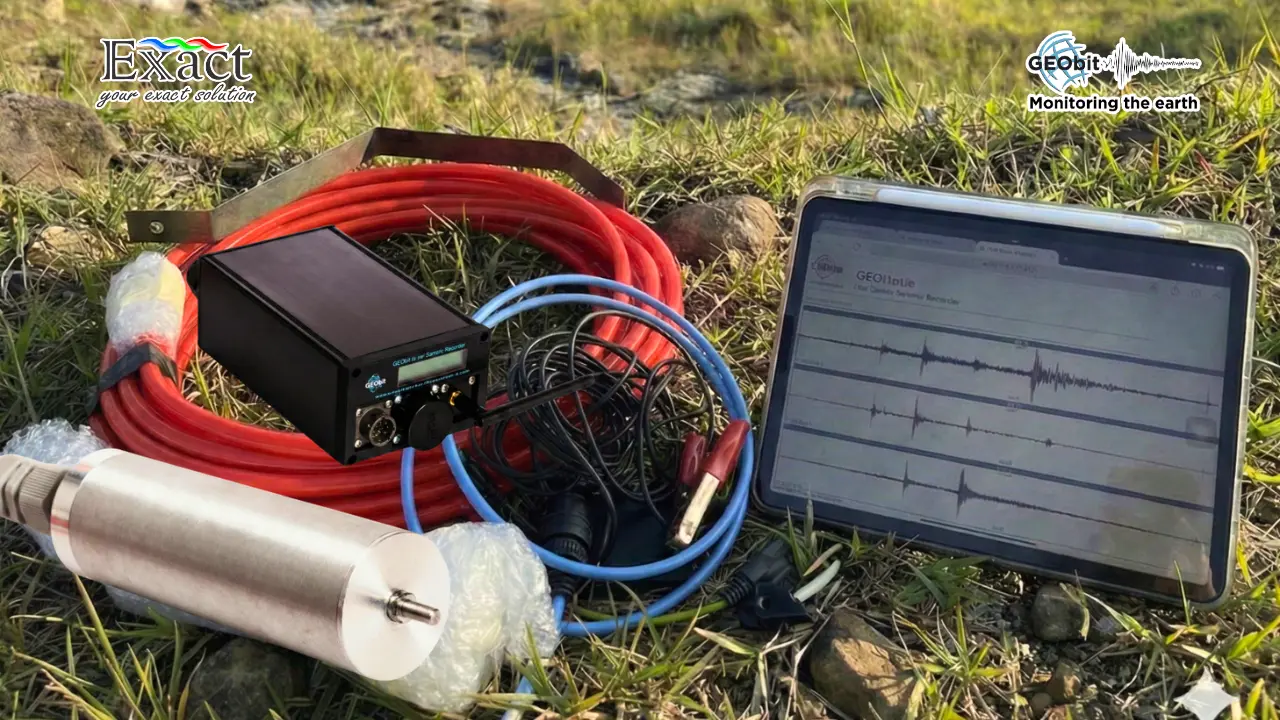
In Indonesia, precision is key for tracking ground activity. Our team offers tools that handle tough geological conditions well. We think reliable equipment is crucial for saving lives by collecting better data.
The C-100 model boasts an amazing seismometer sensitivity of 1500 V/m/sec. It lets us catch tiny ground movements that others might overlook. With this Geobit tool, your research stays precise and professional.
Experts love its role as a top-notch wideband seismometer. It picks up frequencies from 10s to 98Hz clearly. We aim to give local scientists the best tech out there through PT. EXACT GLOBAL TEKNOLOGI, the Indonesia Authorized Sole Agent.
Understanding the Geobit Wideband Seismometer C-100
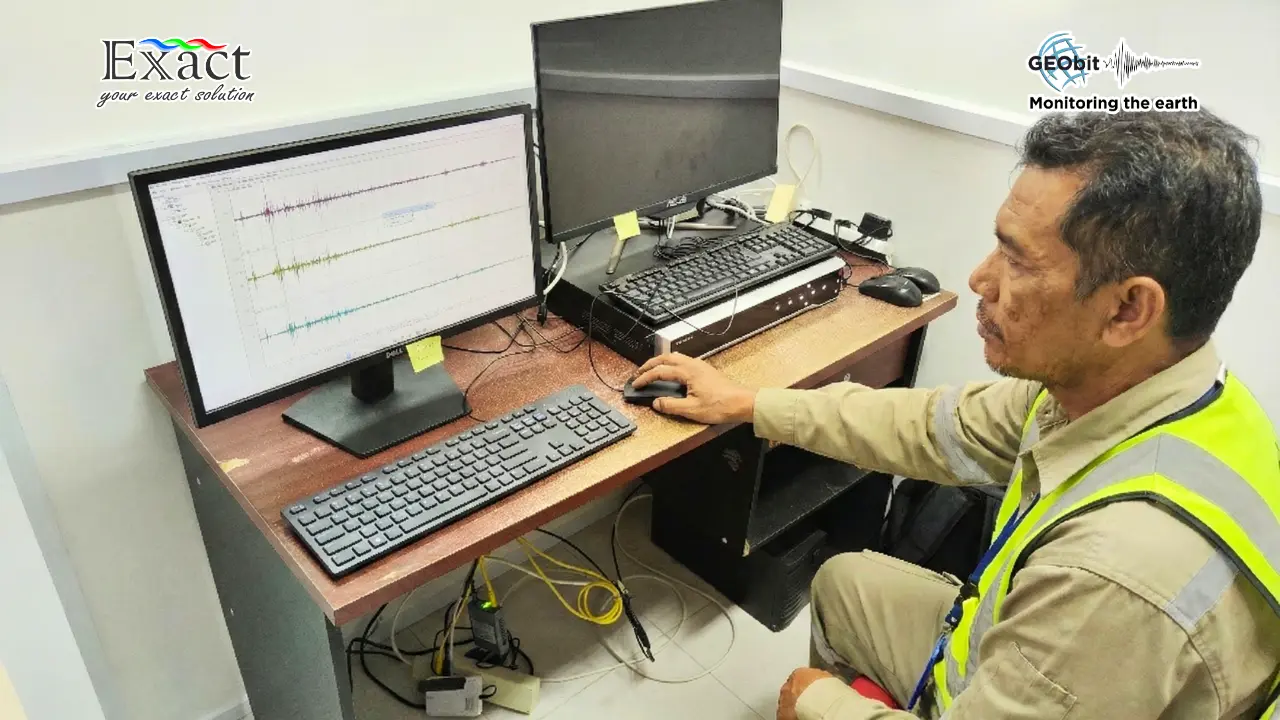
Modern seismic monitoring has been greatly improved by advanced tools like the Geobit Wideband Seismometer C-100. This device is key in finding earthquakes and understanding seismic activity. It’s crucial for areas that often experience these disasters.
The Geobit Wideband Seismometer C-100 offers precise and dependable data over a wide range of frequencies. It’s a vital tool for seismic monitoring and earthquake detection. Its cutting-edge tech can spot both low and high-frequency seismic events, giving a full picture of seismic activity.
Using the Geobit Wideband Seismometer C-100 brings several benefits:
- It’s more sensitive to seismic movements
- It has a wide frequency response range
- It provides reliable data for accurate analysis
We know how important accurate seismic data is for dealing with earthquakes. The Geobit Wideband Seismometer C-100 is a key tool in this effort. It gives vital info to help improve earthquake detection and response plans.
By using advanced seismometers like the Geobit Wideband Seismometer C-100, we can better monitor seismic activity and detect earthquakes. This is especially important for countries like Indonesia, which are in very active seismic areas.
Complete Technical Specifications and Core Features
The C-100 is a three-component velocity equivalent output seismic sensor.
- Frequency Response: 10s to 98Hz Explained, three generations of the C-100 sensor have been manufactured. 10s, 5s, 2s and 1s low cut corner frequencies are available as well as 50, 80 and 98 Hz high corner frequencies.
- Sensitivity Rating of 1500 V/m/s, the sensitivity is 1000 V/m/sec for the Mk1 version while it has been increased to 1500 V/m/sec for the Mk2 and Mk3 versions.
- Physical Specifications and Build, two sensor types are provided, one borehole type and one surface type. The borehole type is housed into a 50mm diameter casing while the surface type unit’s dimensions are only 115\times90\times55mm.
- Power and Data Output Characteristics, it features low power consumption and a wide input voltage range. A build-in test line is also provided for calibration and testing.
Performance Analysis: Real-World Applications
- Low-Frequency & High-Frequency Detection, the bandwidth reaches down to 10sec, with optional versions featuring corner frequencies of 1sec, 2sec and 5sec. It captures high-frequency waves up to 98Hz.
- Dynamic Range and Noise Floor, the noise level is rated to be below NLNM into the recording band.
- Temperature Stability and Environmental Resilience, it works well in an operation range of -20°C to 70°C. It features 100% humidity resistance (IP67) and is submersible up to 1000 meters.
Design and Engineering Quality Assessment
Housing Construction and Internal Sensors, the sensor electronics are housed outside the sensor casing in a separate box (S100 model) or a datalogger (C100/GEOthree/six) thus the damage risk is dramatically minimized. It utilizes a 3-axis velocity sensor with a velocity feedback design. Orientation includes Vertical, North-South, East-West. Geophone resistance is 375 Ohms.
Leveling System and Installation Hardware No mass-lock or centering is required that makes an easy connection with the digitizer. The borehole type features smart elastic clamping and a guiding wheels driver.
| Feature | Description | Benefit |
| Mounting | Borehole type / Surface type | Versatile deployment options |
| Internal Sensors | 3-axis velocity sensor | Accurate 3-component detection |
| Leveling System | No mass-lock or centering required | Rapid 30s settling time |
| Clamping | Smart elastic clamping | Secure borehole installation |
Comprehensive Pros and Cons of the Geobit C-100
Advantages We Observed, The C-100 has a wide response of 10sec-98Hz, 1500 V/m/sec sensitivity, and is submersible up to 1000 meters.
Limitations to Consider, The sensor electronics must be safely housed outside the sensor casing. The default cable length is 20 meters, though it can be extended up to 150 meters.
Practical Applications for Geophysical Monitoring, The sensor is ideal for local and regional earthquake seismology as well as human or induced micro-seismicity monitoring.

| Application | Key Benefit |
| Regional Earthquake Networks | Local and regional seismicity monitoring |
| Volcanic Monitoring Systems | High sensitivity (1500 V/m/sec) for micro-seismicity |
| Mining Operations | Ideal for human or induced micro-seismicity monitoring |
| Structural Health Monitoring | Wideband response capturing up to 98Hz |
Installation, Setup, and Operational Requirements
Site Selection and Installation Process, The borehole type requires a minimum 50mm diameter space and supports up to 150m depth. Setup utilizes smart elastic clamping. The settling time of the unit is very short, only thirty seconds.
| Maintenance Task | Frequency | Description |
| Calibration Verification | As Needed | Utilize the build-in test line for calibration and testing |
| Hardware Inspection | Periodic | Ensure the smart elastic clamping is intact |
| System Connection | Periodic | Verify the connection to the GEOthree/six digitizer |
Why the C-100 Suits Indonesia’s Seismological Landscape
Indonesia requires robust equipment. The C-100 features an IP67 enclosure, 100% humidity tolerance, and operates from -20°C to +70°C.
Data Quality and Integration Capabilities
The noise level remains below NLNM into the recording band. The bandwidth achieves 4.5Hz, 10sec to 98Hz if connected to GEObit instruments.
The Geobit Wideband Seismometer C-100 is a 3-axis velocity sensor with a wide response of 10sec-98Hz and 1500 V/m/sec sensitivity. Its robust IP67 design is submersible up to 1000 meters. Because no mass-lock or centering is required, deployment is exceptionally fast with a settling time of only thirty seconds.
At PT. Exact Global Teknologi, our job is to make sure you have the best gear and the right knowledge to use it in the harshest environments. Because when you eliminate the guesswork from your passive seismic logistics and network design, complex geothermal exploration becomes simple. Let’s get to work.
Click the link below to get your ‘Exclusive Pricing & Project Estimation‘ for the Geobit C-100 package. Our engineering team will deliver a customized quote within 24 hours.
Frequently Answer Questions.
What is the primary frequency range of the C-100?
It features a wide response of 10sec-98Hz. Optional versions with corner frequencies of 1sec, 2sec, and 5sec are available.
How sensitive is the Geobit C-100?
The Mk2 and Mk3 versions feature an increased sensitivity of 1500 V/m/sec (differentially).
Can the Geobit C-100 withstand harsh environments?
Yes. It operates from -20°C to +70°C, features an IP67 enclosure, withstands 100% humidity, and is submersible up to 1000 meters.
Is the C-100 easy to install?
Yes. No mass-lock or centering is required, resulting in a settling time of only thirty seconds. The borehole type utilizes smart elastic clamping.
How is the sensor protected from damage?
The sensor electronics are housed outside the sensor casing in a separate box (S100 model) or a datalogger (C100/GEOthree/six), minimizing damage risk.