Sitting directly on the active Pacific Ring of Fire, Indonesia experiences frequent, severe seismic activity. Because of this geography, Earthquakes in Indonesia present an ongoing threat to our built environment, where ground shaking can compromise structural integrity and endanger human lives.
Constructing Earthquake-Resilient Buildings in Indonesia is a critical national priority. Ensuring a building can withstand severe ground motion requires a deep integration of Earthquake Engineering Design principles to achieve ultimate Structural Resilience. Rigid designs alone are no longer sufficient; we require real-time insight into how our buildings behave when the ground shakes.
This is where Structural Health Monitoring is transforming the industry. By transitioning from slow, manual inspection methods, we can establish a continuous baseline of our building’s health, detect structural changes, track material fatigue, and manage risk objectively. Deployed platforms like mageba’s ROBO®QUAKE serve as the central nervous system for our properties. This off-the-shelf, IoT-compatible monitoring solution ensures we satisfy regulatory codes, support Earthquake Disaster Mitigation, and protect our investments.
Shift to Continuous Oversight: Periodic vs. Real-Time Structural Monitoring
Evaluating building safety after an earthquake historically relied on visual inspections and periodic manual measurements. However, manual inspections are slow, subjective, and fail to detect internal, hidden damage within core support walls. This is why understanding the difference between Periodic vs. Real-Time Structural Monitoring is essential for modern property management. Periodic monitoring involves sending technicians once or twice a year to measure concrete cracks or joint displacement. While helpful for general maintenance, it offers zero protection during sudden, extreme seismic events.
Real-time monitoring operates continuously, 24 hours a day, 365 days a year. A real-time system tracks measured variables and global structural properties in real time, capturing vibrations, ground acceleration, and structural changes as they happen. In active Seismic Zones in Indonesia, this continuous data flow is critical. It establishes a reliable baseline of normal behavior, enabling engineering teams to spot even the slightest drift in natural frequency or track increasing inter-storey drift over time.
By implementing continuous monitoring, we ensure our structures satisfy local and national Building Safety Standards. Instead of waiting for a yearly inspection, we receive immediate alerts if any boundary value is exceeded. This proactivity identifies potential failures before they become visible, optimizing maintenance schedules and extending the service life of critical infrastructure.
High-Precision Instrumentation: How Building Earthquake Sensors Work
Understanding how building earthquake sensors work is key to evaluating their reliability. Standard commercial motion sensors are often too slow or noisy to capture the complex, low-frequency vibrations that travel through concrete structures during an earthquake. To obtain engineering-grade data, we rely on specialized triaxial force-balance accelerometers.
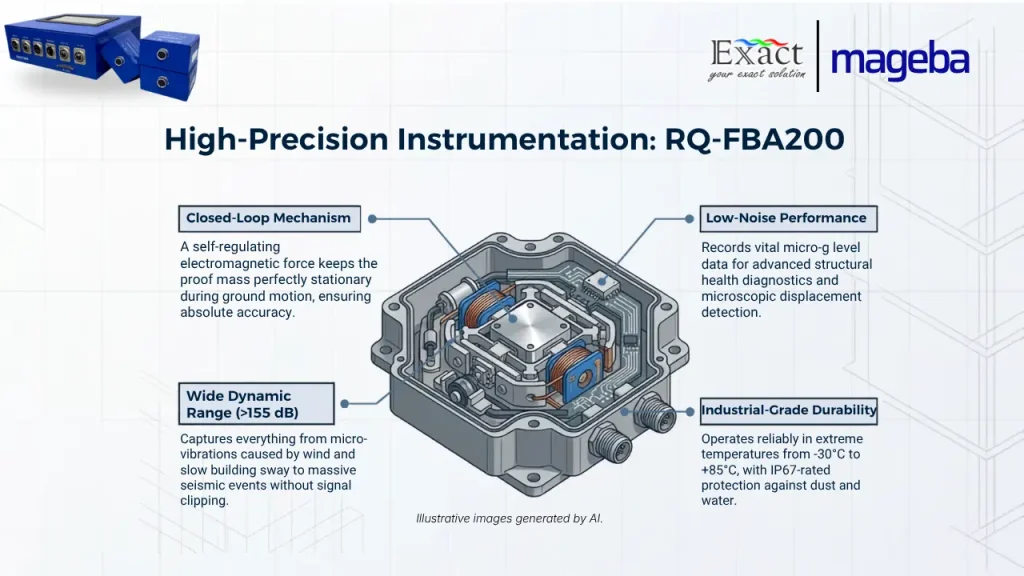
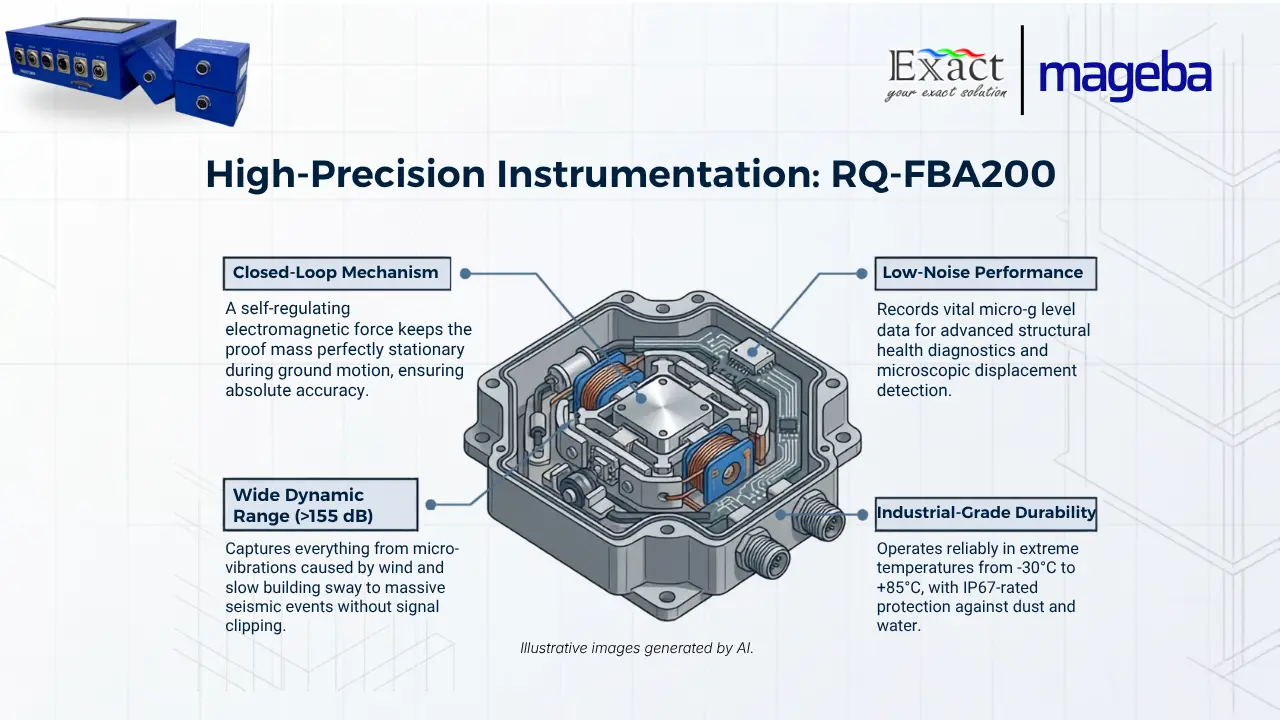
ROBO®QUAKE comes standard with the highly sensitive RQ-FBA200 model sensor, which is a state-of-the-art Force Balance Accelerometer (FBA). Unlike conventional accelerometers using simple MEMS or piezo-electric crystals, an FBA utilizes a closed-loop feedback mechanism. The sensor contains an internal proof mass that, when shaken, is kept completely stationary relative to the housing by a self-regulating electromagnetic force. This electromagnetic force is measured, and it is directly proportional to the acceleration experienced by the structure.
This advanced closed-loop design gives the RQ-FBA200 sensor an exceptionally wide dynamic range of greater than 155 dB, excellent linearity, and extremely low self-noise. This low-noise performance, kept at the micro-g level, is vital for structural health diagnostics. It means the sensor can detect minute micro-seismic vibrations, slow wind-induced swaying, and long-term building tilts, while also capturing massive, high-amplitude earthquake shocks without clipping. The sensor is built to operate in extreme conditions, with an operating temperature range of -30 °C to +85 °C and an IP67-rated enclosure.
Zero Human Hesitation: Actuating Building Protection Equipment
During a severe earthquake, every second counts. Secondary hazards—such as fires from broken gas lines, trapped occupants in elevators, and localized flooding from ruptured water pipes—frequently cause more casualties and financial loss than the shaking itself. To prevent these disasters, our building safety systems must react instantly, without relying on human intervention.
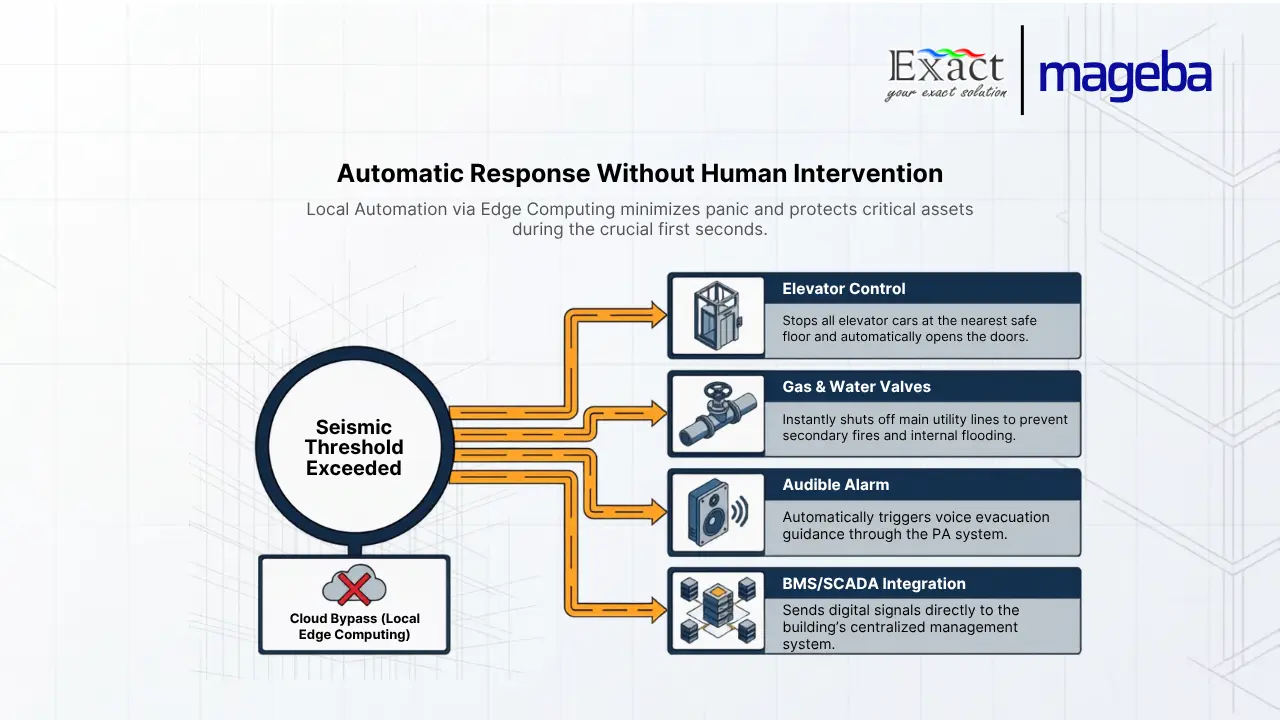
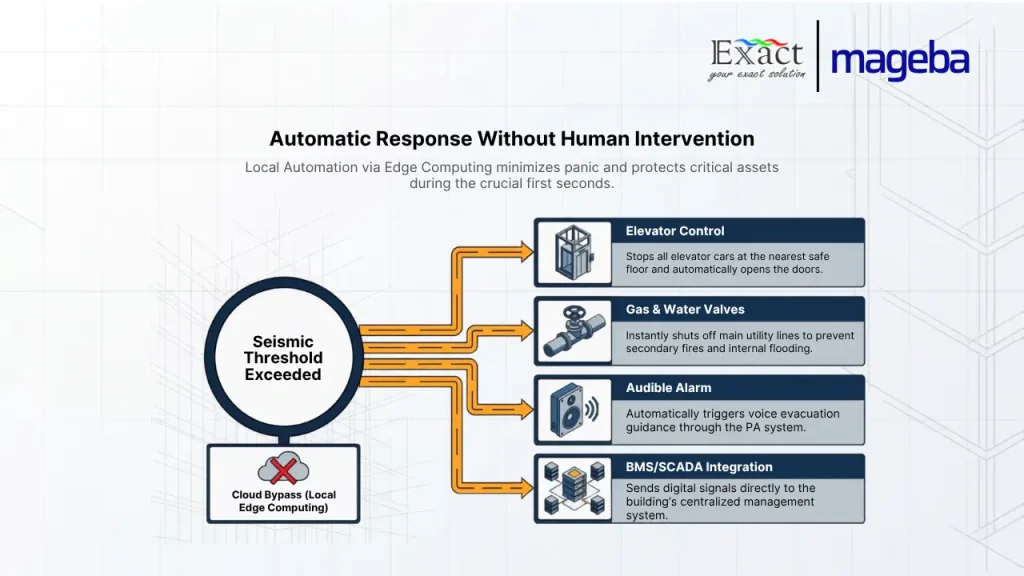
ROBO®QUAKE is designed to act as an active safety barrier by directly connecting to critical building protection equipment. When the high-precision triaxial accelerometers detect that ground acceleration has crossed a dangerous, predefined threshold, the main data unit processes this information locally. Using on-site edge computing, the system bypasses the need for cloud or network connectivity and instantly triggers the building’s mechanical and electrical safety systems:
- Elevator Control: Stops all elevator cabs at the nearest safe floor and opens the doors immediately, preventing occupants from getting trapped.
- Gas & Water Shut-Off: Instantly closes automatic shut-off valves on main gas lines and water supply pipes to prevent explosions, fires, and interior flooding.
- Acoustic Alarms: Automatically triggers public address (PA) alarms and plays pre-recorded acoustic evacuation messages to guide tenants safely.
- BMS Integration: Sends digital signals directly to the central Building Management System (BMS) or SCADA network for coordinated emergency responses.
By automating these protocols, we remove human panic and hesitation from the emergency response loop, saving lives and protecting property in the first crucial seconds.
High-Rise Vulnerabilities: Earthquake Detection Technology for High-Rise Buildings
High-rise buildings face unique structural challenges during an earthquake. Due to their height, these structures have low natural frequencies and are highly susceptible to wind-induced vibrations, lateral sways, and the whiplash effect of seismic waves. In dense urban centers like Jakarta, managing Earthquake-Vulnerable High-Rise Buildings requires specialized tools beyond basic regional seismographs.
We deploy advanced earthquake detection technology for high-rise buildings to capture these dynamic movements. As seismic waves travel upward, they can amplify, causing severe inter-storey drift and structural twisting. ROBO®QUAKE is designed specifically to handle these challenges, offering sampling rates of up to 1,500 samples per second (SPS) and solid-state drive (SSD) storage with unlimited recording capacity.
This high data acquisition rate allows our engineering teams to track exactly how the building sways on its X, Y, and Z axes. The system’s local software automatically categorizes event intensities and performs spectral analysis, calculating Peak Ground Acceleration (PGA), Peak Ground Velocity (PGV), and Peak Ground Displacement (PGD) directly from the raw data. By continuously monitoring the vibration status of critical structural elements on different floors, we can detect material fatigue, evaluate Structural Ductility, and ensure our properties meet the highest safety and compliance standards.
Ensuring Code Compliance: Strict Sensor Placement Guidelines
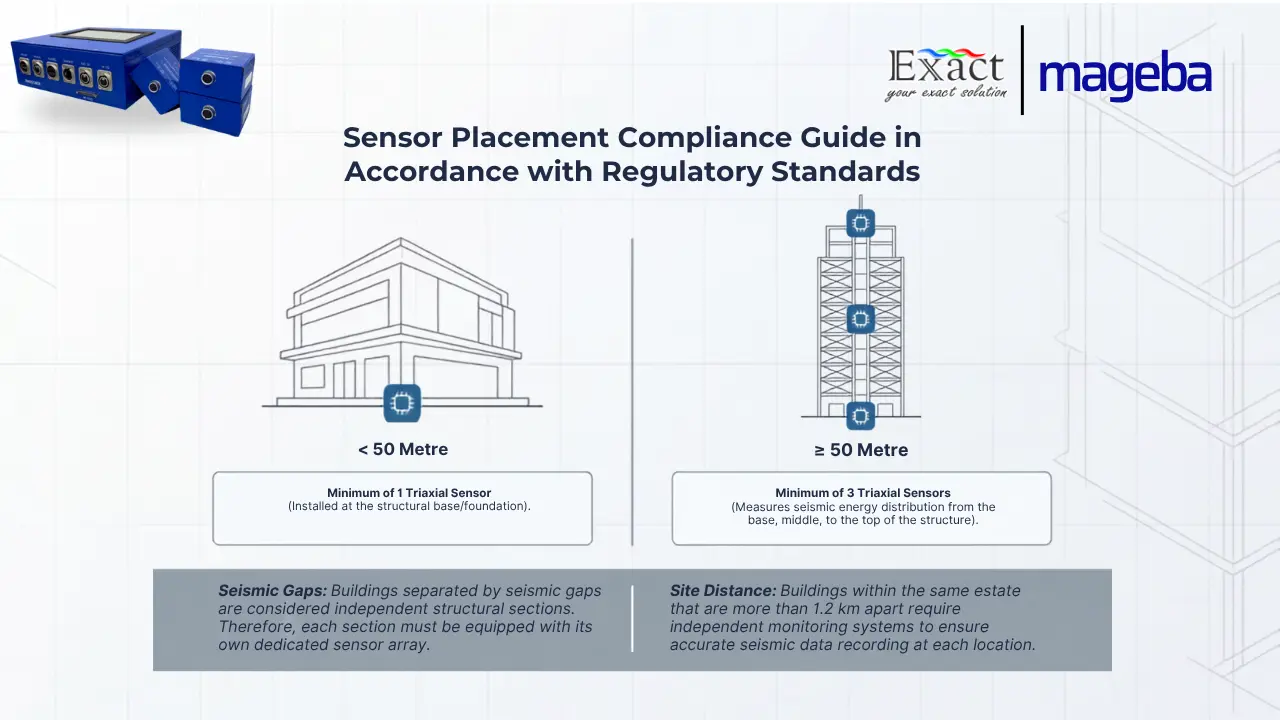
To collect accurate, legally compliant data, we must follow strict engineering guidelines for sensor placement. The design of our monitoring network must reflect the building’s physical dimensions and structural complexity, as outlined in official seismic monitoring questionnaires.
Height-Based Compliance The total height of a building dictates the minimum number of accelerometers required:
- Below 50 Meters: A minimum of 1 triaxial accelerometer sensor is required, typically installed at the base of the structure.
- 50 Meters or Taller: A minimum of 3 accelerometer sensors are required. These are strategically positioned at the bottom, middle, and top floors to measure how seismic energy travels through the height of the structure.
Managing Seismic Gaps Structural seismic gaps allow separate sections of a massive building to move independently during a quake, preventing collisions. If a building is divided:
- 1 seismic gap per floor: The building is treated as 2 separate sections.
- 2 seismic gaps per floor: It is treated as 3 independent sections.
- Placement Compliance: We must install the required height-based sensors in each separate section. A 60-meter high-rise with two seismic gaps, for instance, requires 3 sensors per section, totaling 9 sensors across the complex.
Estate Distance and Shared Utilities If buildings in an estate are located more than 1.2 kilometers apart, independent monitoring systems are required. Additionally, we must evaluate if they share infrastructure like underground garages, utility rooms, or common spaces. These shared elements can influence how vibrations travel between buildings, requiring networked or synchronized systems.
Instant Assessments: Post-Earthquake Structural Monitoring and Analysis
Following a severe earthquake, operators face an immediate, critical question: is the building safe to enter, or has it suffered core structural damage? Relying solely on manual inspections by structural engineers is slow and labor-intensive, keeping businesses closed and causing expensive operational delays.
This is where post-earthquake structural monitoring and Post-Disaster Structural Assessment become invaluable. ROBO®QUAKE completely automates this assessment. Within minutes of a seismic event, the system processes raw sensor data to generate a comprehensive, easy-to-read Event Report. This document is delivered instantly via email, SMS, or WhatsApp to managers and engineering teams.
Rather than presenting a confusing spreadsheet of raw numbers, the report summarizes the shaking duration, intensity level, and peak values for acceleration, velocity, and displacement. Most importantly, it generates 3D projections of acceleration and displacement along the X, Y, and Z axes. This allows engineers to see exactly how the building twisted and swayed. By comparing real-world movements with the building’s design parameters, engineers can make rapid, objective re-occupation decisions, minimizing downtime while protecting public safety.
Disaster-Ready Design: Hardware Redundancy and On-Site Integrity
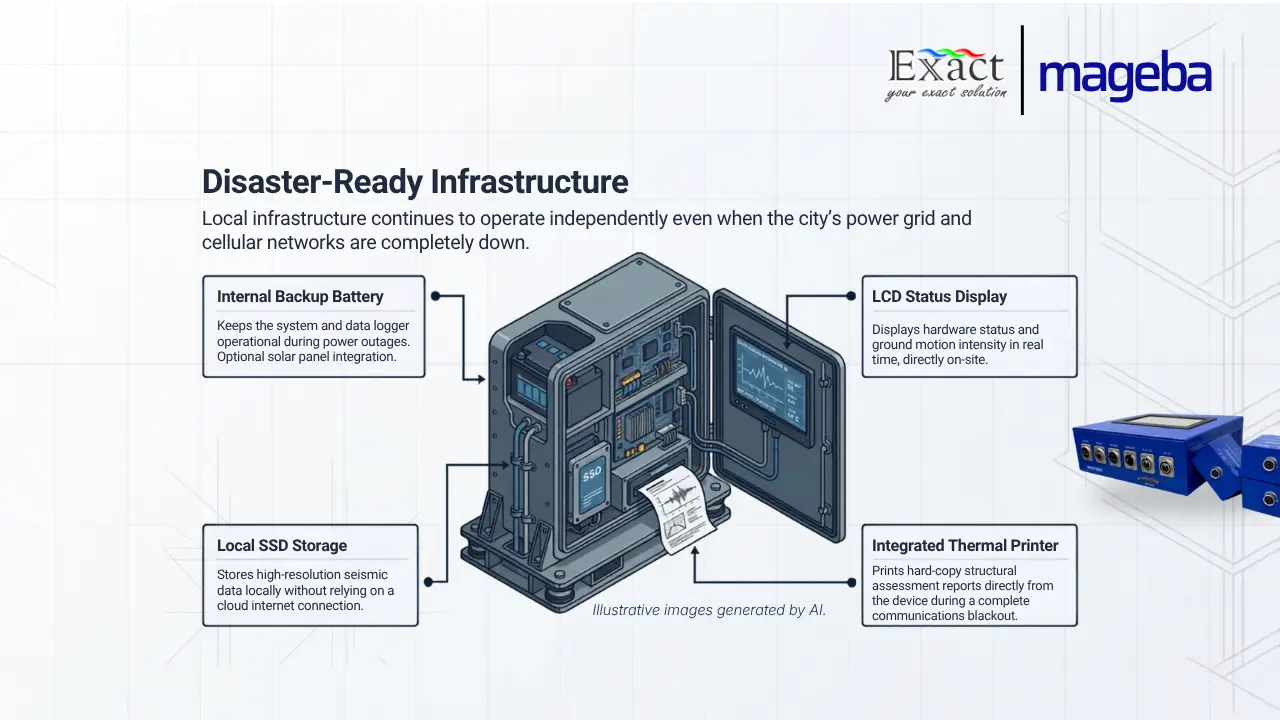
Seismic events often destroy local infrastructure, triggering power outages and cellular network failures. A monitoring system is useless if it stops working during a disaster. Therefore, we design ROBO®QUAKE with robust hardware redundancy and on-site accessibility.
The industrial-grade Main Data Unit is housed in a heavy-duty, protective enclosure. To ensure continuous operation during a blackout, the system features a built-in backup battery that keeps sensors and data-loggers running. It can also be paired with optional solar panels for mains-independent power.
The unit utilizes a high-capacity solid-state drive (SSD) to record seismic events locally, protecting data from physical shocks. If networks go down, on-site edge computing processes and stores the data locally. Facility managers can access this information directly at the installation site. The unit features a top-panel LCD screen showing hardware status and event intensity. It also includes a built-in thermal printer, allowing emergency teams to print physical copies of post-disaster reports directly from the box, even in a complete communication blackout.
Digital Twin Technology: Transforming Structural Reliability and Maintenance
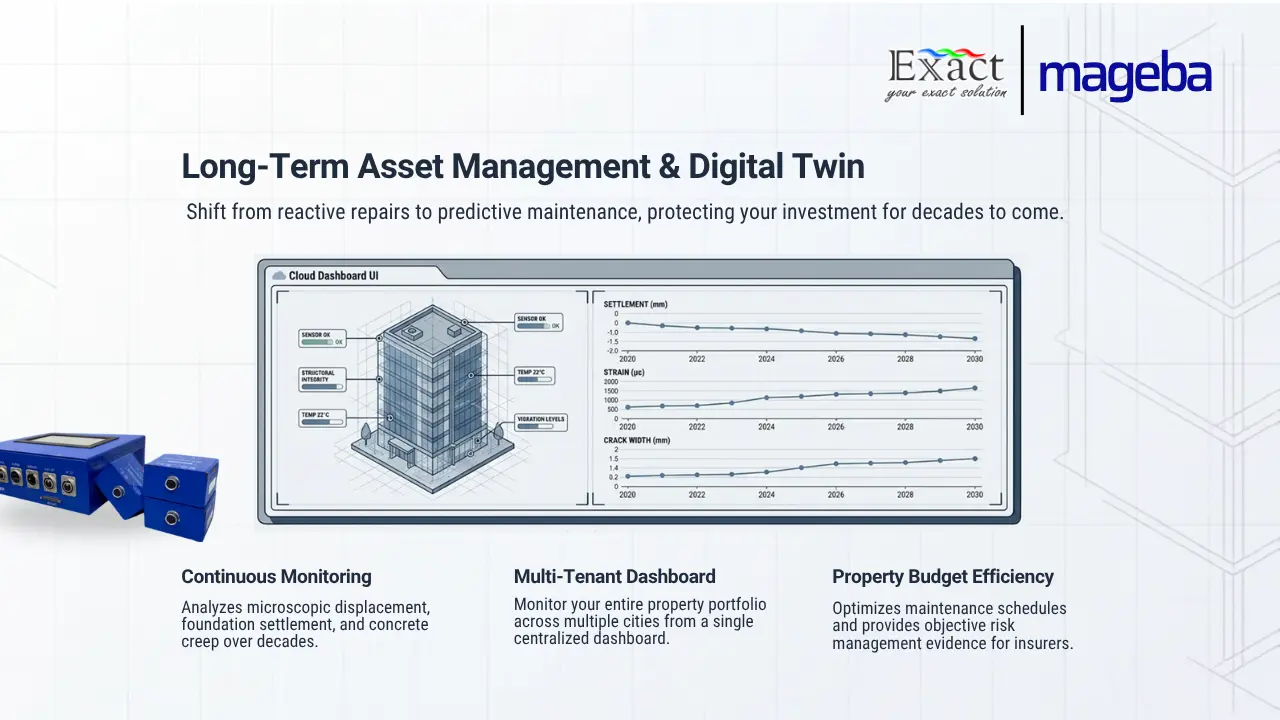
While emergency alerts are vital, long-term asset management requires a proactive approach to maintenance. Over decades of service, buildings undergo gradual physical changes due to material fatigue, environmental factors, and micro-seismic events. To manage these risks, we leverage mageba’s cloud-based Digital Twin Platform.
This platform creates a highly accurate, virtual digital replica of physical structures and components. By continuously streaming real-time data from ROBO®QUAKE and other integrated sensors to the cloud, it compiles a historical record of our building’s behavioral patterns. We can easily monitor long-term trends like concrete creep, foundation settlements, or microscopic joint displacements.
The platform uses machine learning to identify subtle anomalies indicating structural wear. This allows us to shift from expensive, reactive repairs to a highly optimized predictive maintenance model. Through centralized, multi-tenant dashboards, property developers can view the live status, historical logs, and 3D model visualizations of multiple properties across different cities on a single screen. This high-level transparency helps us optimize maintenance budgets, plan strategic renovations, and prove proactive risk management to insurance providers.
Technical Support and Local Distribution: PT. Exact Global Teknologi
Implementing a sophisticated Structural Health Monitoring System (SHMS) requires deep technical expertise, from initial sensor placement design to ongoing hardware calibration and support. In Indonesia, mageba’s advanced seismic safety systems are supported and distributed locally by PT. Exact Global Teknologi.
As a trusted partner in structural safety and disaster preparedness, PT. Exact Global Teknologi provides comprehensive, turnkey solutions for building compliance. Their team of specialist engineers works closely with developers, project managers, and structural designers from the initial conceptual stages of a project. They assist in analyzing building geometries, determining optimal sensor layouts, executing professional installations, and providing long-term maintenance and technical support.
Partnering with PT. Exact Global Teknologi ensures properties are compliant with local standards, backed by mageba’s global engineering excellence.
For inquiries, technical consultations, or to request a customized seismic monitoring layout for your project, please contact:
- Company Name: PT. Exact Global Teknologi
- Website: www.exactglobal.co.id
- Email Marketing: marketing@exactglobal.co.id
- WhatsApp Support: +62 812-9252-3900
Frequently Asked Questions (FAQ)
What is an earthquake-resilient building, and how does ROBO®QUAKE support it?
An earthquake-resilient building is a structure designed and monitored to withstand severe ground shaking while protecting human life and maintaining operational continuity. ROBO®QUAKE acts as a real-time “nervous system” for these buildings, using high-precision accelerographs to track structural movement, trigger safety equipment, and generate immediate safety assessments after a tremor.
How does a Structural Health Monitoring System (SHMS) improve public safety?
Unlike visual inspections that happen months after an event, an SHMS continuously measures structural behavior in real time. By providing immediate alerts when safety thresholds are exceeded, the system allows for rapid evacuations and prevents secondary disasters. It also provides engineers with objective data to determine if a building is safe to re-enter.
How do ROBO®QUAKE’s building earthquake sensors work?
The system utilizes advanced Force Balance Accelerometers (FBAs), such as the RQ-FBA200. These sensors use a closed-loop feedback mechanism that applies an electromagnetic force to keep an internal proof mass stationary during shaking. By measuring this force, the sensor records acceleration with extremely high accuracy, low noise, and a wide dynamic range.
Can ROBO®QUAKE automatically shut down elevators and gas lines?
Yes. Through edge computing, the Main Data Unit can be wired directly to the building’s mechanical and electrical systems. Immediately upon detection of hazardous ground motion, the system automatically stops elevators at the nearest safe floor, shuts off gas and water valves, and activates evacuation alarms, preventing fires and flooding.
What is the difference between periodic and real-time structural monitoring?
Periodic monitoring involves manual measurements taken at set intervals (e.g., yearly), which cannot capture transient seismic events. Real-time structural monitoring is continuous, capturing sudden ground motions and structural responses as they occur, providing immediate data for emergency response and predictive maintenance.
How many sensors are required for building compliance in Indonesia?
Sensor quantity is based on building height and architectural design. Buildings under 50 meters require at least 1 sensor. Buildings 50 meters or taller require at least 3 sensors (placed on the bottom, middle, and top floors). If the structure is divided by seismic gaps, each independent section must meet these requirements separately.